A Few Words About Historical Events and Polish-Ukrainian and Ukrainian-Polish Relations from a Lawyer’s Point of View.
Recently, the media have been trying to raise complex issues of relations between Poles and Ukrainians and actively discuss events of the past, better known as the Volhynia tragedy. What did really happen then? Who did what and who is to blame is a question better left to historians who study this topic, rather than to contemporary lawyers, diplomats, and politicians. The fact is that the participants in those events are long gone, and the current generation of Poles and Ukrainians has no connection to them. Modern Ukrainians and Poles have nothing to repent for and no need to justify themselves to each other. They have no connection to those events, as they were not even born at that time.
If a purely historical approach were used in jurisprudence, diplomacy, and politics, then the Ukrainian side could also make claims against the Poles, especially for that period of our shared history when the Polish nobility exploited Ukrainians, which led to a series of uprisings and the intensification of national liberation movements. It is well known that in the 17th century, the short-sighted policy of the Polish government led to the uprising of Bohdan Khmelnytskyi, which prompted the latter to conclude an alliance with Russia. It is now common knowledge that this had catastrophic consequences for both Poles and Ukrainians in the long run.
Hence the conclusion. History must be studied and known, but in order to build modern international relations on its basis, and in order to take into account the mistakes of the past and avoid them in the future.
The examples given clearly demonstrate that a purely historical approach cannot be used to regulate modern international legal and political relations, because if we follow this logic, we could go back to the time of Adam and Eve and still not reach a result mutually acceptable for both sides.
Here it is worth pointing out once again that
in the past there were different historical conditions, different socio-political relations and legal realities that have nothing in common with the relations that have developed between Poles and Ukrainians at the current stage of historical development and our current relations.
Obviously, there are and always will be forces interested in using historical facts and their biased interpretation to achieve their own political goals or realize imperial ambitions and aggressive plans.
For example, after the full-scale invasion of Ukraine, Russia began to make great efforts to drive a wedge between Poles and Ukrainians and destroy their good-neighborly relations.
It is well known that at the beginning of the war, Poland was one of the first countries to condemn Russia’s aggression and provide Ukraine with real military and humanitarian aid. Besides, today Poland is the main logistics hub through which Western weapons and equipment are delivered to Ukraine. Obviously, this fact cannot be ignored by Russian special services, and therefore they use various methods of informational and psychological influence, including historical facts, to sow discord between Poles and Ukrainians. The logic of the Russians here is quite simple and understandable.
After conquering Ukraine, Putin planned to attack Poland and other countries in Central and Eastern Europe. For Russians, this would have been the beginning of the restoration of Russia’s military and political influence in the post-Soviet space. But Ukraine
withstood the blow, which ruined the plans of Putin and his associates.
There is no doubt that the current Polish government and the vast majority of Poles understand the threat that modern Russia poses to their independence and state sovereignty. This conclusion can be drawn not only from an analysis of current events, but also from a review of the history of Russian-Polish relations.
Today, Poles and Ukrainians must base their interethnic and interstate relations exclusively on pragmatic considerations and national interests. The governments of both countries must objectively assess the realities of the present and not succumb to provocations from Russia and its special services. The current generation of Poles and Ukrainians should be more concerned with the future of our nations than with searching for reasons for discord based on historical facts and mutual grievances that remain in the distant past.
It is worth reiterating that the current generation of Poles and Ukrainians has no connection to those historical events, neither to the Volhynia tragedy, nor to the Khmelnytskyi Uprising, nor to the Koliivshchyna Uprising, nor to any other tragic pages of our shared history. Therefore, today’s Polish and Ukrainian lawyers, diplomats, and politicians need to take into account the lessons of the past, but only in order to avoid similar mistakes in the future. Together, we must ensure that the negative facts of our history remain in the past, and that Ukrainian-Polish and Polish-Ukrainian relations are built not on the basis of past mutual claims and grievances, but on the norms and principles of modern international law, based on the current common national interests of Poles and Ukrainians and the prospects for their mutually beneficial development in the future.
Oleh Bereziuk,
Institute for Global Politics.
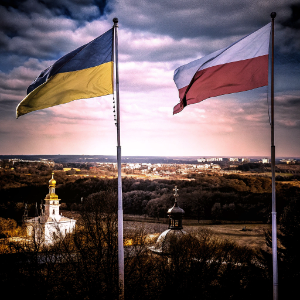
(Image generated by neural network)